Remittances to Mexico: the corridor after the boom
The world's second-largest remittance market just had its first down year in more than a decade. 20 pages on the pandemic surge, the 1% federal tax, a sealed border, and why the official numbers no longer tell the whole story.
The corridor in four numbers.
Seven chapters, every figure traced to its source.
Written for payments executives, product owners at banks and fintechs, and anyone pricing, building or regulating the US–Mexico corridor.
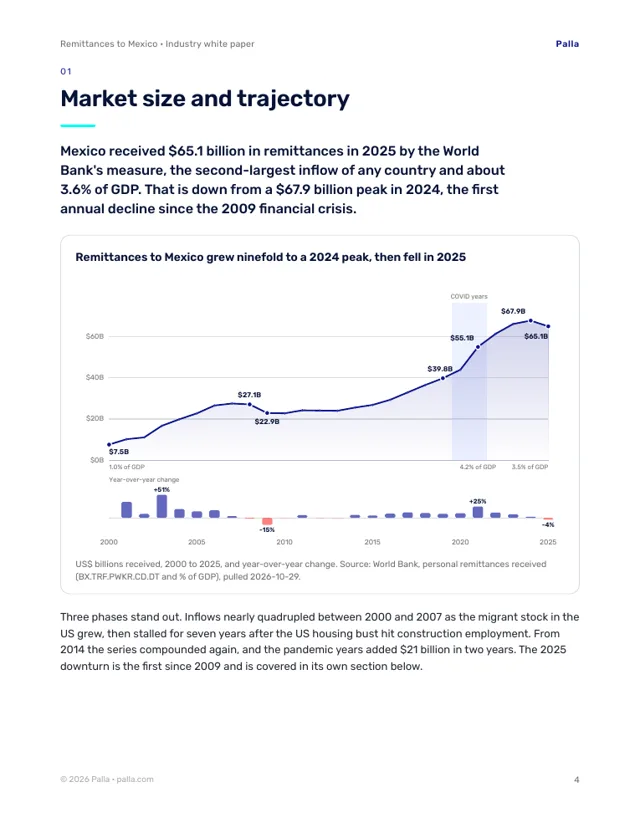
- Market size and trajectoryFrom $7.5B in 2000 to a $67.9B peak in 2024, and where Mexico sits among the world's recipients.
- The US–Mexico corridorWho sends, how it moves, where it lands and what it costs, down to the cheapest services in the World Bank's survey.
- COVID-19: the forecast collapse that became a boomWhy a predicted 20% fall became +12% and +26%, and what it rewired for good.
- The political environmentThe 1% remittance tax, section 4475, FinCEN's border order and Mexico's Finabien refund, with a dated timeline.
- 2025–2026: the first decline in eleven yearsFewer, larger transfers, four causes, and why Mexico was the regional outlier.
- The measurement gapStablecoin rails, informal cash, illicit flows and revisions: what Banxico's series counts and what it misses.
- Implications for operatorsSeven conclusions on funding method, payout, pricing, compliance and market sizing.
Size the corridor with more than one series, and see how the 1% tax and FinCEN's border order change the economics of cash versus account funding.
Where price competition moved share, why FX is the price, and what rising tickets and falling counts mean for percentage versus flat fees.
Section 4475 as enacted, the proposed regulations, Finabien's refund, and the reporting burden on every rail, cash, card and stablecoin.
Ready to move money instantly?
Get a 30-minute partner walkthrough. We'll show you the API, the checkout, and the economics for the US–Mexico corridor.